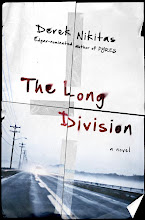
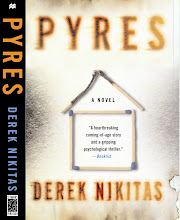
All good things must come to an end, or be renewed. Time and technology have rendered this blog site rather obsolete, so from now on I'll be posting news and updates on my blog at dereknikitas.com.
Please stop by there soon.
Oh, and my new novel, EXTRA LIFE, will be released on October 13th, 2015!
Monday, October 5, 2015
Last Post

Monday, May 18, 2015
What Went Wrong with Last Night's Game of Thrones?
Spoilers, obviously.
There’s been a bit of an internet uproar about last night’s
episode of Game of Thrones, “Unbowed, Unbent, Unbroken,” especially in regards
to the last few minutes after Sansa Stark and Ramsay Bolton’s wedding (though
there are also problems with the hasty treatment of the Dorne storyline and the
inexplicable re-emergence of Jaime’s fighting prowess).
Some viewers lament how the showrunners have deviated from
George R. R. Martin’s original novels, but now that the show has outpaced the
books in several story lines, deviations are to be expected. It’s a matter of
the quality of the deviations, and
whether they adhere to the spirit of the books, and, by extension, previous
seasons of the television show.
Other viewers lament the sexual brutality of the scene, and
this concern is far more important, far more worthy of discussion. Certainly
there are serious issues about agency and the treatment of women, of using rape
as a plot point.
I’m going to discuss storytelling technique, but I’ll admit
that what I have to say is trivial compared to these concerns. Hopefully,
though, I’ll get around to saying something useful about the ethics of this episode’s storytelling,
which are inextricably linked to the technique.
Martin’s A Song of Ice
and Fire universe is loaded with brutality and ugly turns of fate. His
storytelling tests the limits of how often our hopes about his characters can
be dashed before we lose all faith. Certainly, Martin has to keep a careful
balance between shocking us with setbacks for heroes and maintaining a sense of
hope. If we lose the latter, we’ll get the sense that there is no moral core to
this universe, and the structural integrity of his fantasy world would crumble.
If the fictional world is meaningless and arbitrary, we
disconnect.
Martin’s high-fantasy world is innovative because the moral
rules are not simple dark/light, good/evil. His work is a brilliant exploration
of moral paradoxes, of pulling the reader in several directions at once, of
defamilarizing our judgment. His shocking plot points may be brutal, but they’re
also deliciously ironic and paradoxical on a moral level. We hate what they do, but we love way they say.
His plot points—such as the loss of Jamie’s hand, which I
discuss in a previous
post—are full of resonating layers of meaning. Even when the death of the
Red Viper dashes our hope, we can see that it is a morally meaningful plot point. On the simplest level, we understand that
the Red Viper can’t win a decisive victory against the Mountain because Tyrion
has already previously won a trial-by-combat in the Eyrie using Bronn as his
champion.
He can’t do it again, if for no other reason than because
the fatalism in Martin’s world won’t allow for the same moral note to be struck
twice in exactly the same way. In a morally arbitrary world like our own real
world, the same damn thing can happen over and over. It’s exactly that kind of arbitrariness
that we resist in fiction.
So now we come to Ramsay’s rape of Sansa, with Theon in
attendance. This moment was never written by Martin. Like many other Game of Thrones moments, it’s brutal,
but unlike many other Game of Thrones moments, the brutality
is morally meaningless. Unlike, say, the Red Wedding, when we feel a
simultaneous dismay and paradoxical knowingness about Robb Starks’s hubris, we
feel only dismay for Sansa and her treatment by Ramsay.
I’ve been interested in Sansa’s character arc from the
start, as she’s evolved from a bright-eyed and rather snotty dreamer to a
victim to a shrewd mistress of her own fate. Or, at least, she’s been headed
toward that latter category. It’s been deliciously ironic that her progress as
a character has been largely based on the tutelage of Littlefinger, a villain
her mother deeply distrusted. Furthermore, it’s been wonderful to see (or at
least suspect) that Littlefinger’s perfect political calculations may be
endangered by his emotional attachment to a helpless young lady. He would be
her deliverance, and she would be his undoing. There’s a wonderful elegance in
that.
Sansa begins as a naïve young lady betrothed to a handsome
prince. She consents, but has no understanding or agency in her consent. The irony is that the prince is a brutal monster.
Once she realizes this fact, it’s too late, and we fear that she will be victimized
by him. Indeed, he tries to sexually victimize her, but at least she’s spared a
wedding night with him (and, furthermore, she’s allowed to have an unwilling hand
in Joffrey’s death, and she’s blamed for it, too).
Her next forced betrothal, this time to Tyrion, is the
perfect ironic contrast to the first. Tyrion is a “monster” on the outside, but
because he is a (complicatedly) moral creature at heart, she never has to
suffer nonconsensual sex with him. Her marriage to Tyrion is also the beginning
of her path to political shrewdness. She’s the only Stark left inside the
political arena, the only one still playing the “Game of Thrones.”
What, then, is Sansa’s marriage to Ramsay? In terms of moral
resonance, the story was headed in the right direction, even as it deviated
from Martin’s books. This time, Sansa is willingly undertaking this marriage, or
at least she thinks she is, and the fact that she doesn’t realize she’s being
manipulated by Littlefinger is a part of her character flaw. She’s only had to
deal with outwardly monstrous villains.
This time, Sansa is shrewd and in
control, and she’s out for vengeance with her black-dyed hair.
But then it all gets literally washed away. Sansa’s agency
is stolen from her, and she is raped. This plot point grossly and clumsily
reiterates her betrothal to Joffrey. Ramsey is the same kind of monster, and
Sansa is the same kind of victim, and the only difference this time is that
Sansa’s being put through the exact sexual torture Joffrey put her through. It
is merely intensified, not changed.
Furthermore, in the beginning of the story, Sansa’s
virginity was a political playing piece that other characters used. She has no
choice in whether Joffrey or Tyrion took her virginity, but the fact that they
did not meant something. It meant that she could develop as a character
long enough that her virginity became something she had control over. It could be her choice to keep it or use for
whatever emotional or political reasons she saw fit.
(I’m not suggesting it’s morally right that a girl’s
virginity be a political concern; I’m merely acknowledging that it very much is in Martin’s quasi-medieval world, and
in our world).
But her wedding night with Ramsay ruins all that. The redundancy
of Ramsey/Joffrey, and the cynical reversal of the deliverance Sansa earned
from Joffrey, effectively cancels out all of Sansa’s character progress and
retracts any agency she’s earned through the seasons. It’s dismay for the sake
of dismay, without any ironic resonance. We can feel nothing about it except
pity.
It didn’t have to be that way. What if, for example, Sansa
consensually lost her virginity to Littlefinger? The story seemed to be headed
in that direction. It would be a wonderfully paradoxical plot point because Sansa
would have agency and choice; she’d be deliberately abandoning the “honor” and attendant
naiveté of her position as a noblewoman. She’d be spitting in the face of the
false pageantry of it all.
At the same time, she’d be unwittingly giving in to the Baelish
charms that her mother pointedly resisted much of her life. It would be a
beautifully ironic win/lose. It would be awful and it would be subtly brutal,
because we know that Sansa wouldn’t really be consenting to anything, (she’s
too young, and still too innocent about monsters who seem to be charming) but
it would be meaningful as a point of
character progress for Sansa.
But Ramsey Bolton? He should’ve been a piece of cake for her.
The Ramsey/Sansa plot point might’ve worked if Sansa had maintained her agency
and carefully manipulated him without becoming a victim. Or it might have
worked if Ramsey himself had surprised us in some believable way (actually
trying to be respectful, now that he’s a lord, for example). I have a feeling
the showrunners have Sansa’s vengeance in mind for the long game, but they blew
the progress of that storyline in one terribly ill-conceived and morally
bankrupt moment.
Not to mention, when Sansa’s vengeance does comes, it’ll now
be too morally simplistic and inevitable.
Worst of all, they made Theon the focus of the scene, as if
this were Theon’s moment to save the
damsel. Nothing in the moral landscape of the story would suggest that Theon
would be of any use, or any resonant meaning in this moment. The storytelling is guilty of both moral redundancy
and moral bankruptcy. All we learn by focusing on Theon is that he’s still in
Ramsay’s thrall. We’ve already been made to understand that several times over,
and nothing changes as we pointlessly watch him watch.
Yes, it’s true that we haven’t yet seen the fall-out of this
specific plot point. Undoubtedly, there will be consequences for Ramsay and
Theon, but I’m skeptical that any subsequent turns will justify the
backtracking and morally empty brutality of this scene.
Thursday, September 26, 2013
Flaubert's Micro-Astonishments
My last post on Game of Thrones and all my recent,
unwritten musings on the masterful concluding chapters of Breaking Bad have got me thinking again about Madame Bovary, which is a pretty weird thing to say, I know.
But I’ve been teaching Bovary again and I’m struck by how the
novel continues to compel my vested interested despite its surface
near-plotlessness. Is it just that a
novel like Bovary and a novel like Game of Thrones fire entirely different
synapses in the brain, and no reconciliation between their pleasures can be
found?
I don’t know.
One thing is certain. Flaubert is not a good storyteller.
In Flaubert’s letters from during
the writing of Bovary, he admits his
disinterest in plot—in fact, he deliberately sets out to write a book “about
nothing,” focusing on something other than dynamic plot events. Certainly, Bovary is not plotless. It’s
a familiar adultery-and-repercussions narrative. But Flaubert seems to suggest that explosive plot
events would have a detrimental effect on his aim to explore the recesses of
his characters’ psyches.
If we push the metaphor a bit
further, an explosive plot event is kind of like a gun going off. It’s exciting, it makes your heart leap, but the
fraught anticipation of it is distracting, and it leaves you deaf to any
subtler sounds for several minutes thereafter.
I don’t believe that’s always the
case, but for Flaubert and Bovary, it
may be true.
So, quite intentionally, Flaubert
was not a good storyteller. Not if we mean
those classic Aristotelian virtues of compelling events, action-orientated
characters, surprise reversals and revelations, suspense, momentum. These are the elements we typically note as
"good storytelling," and what we find in abundance with an author like
George R.R. Martin. These are the age-old elements of epic and romance,
the very “cheap thrills” that Flaubert was satirizing in Bovary through Emma’s delusions.
If we look at the history of the
development of “the novel,” it’s clear that all the developments and innovations
since its inception have been movements away
from those elements we tend to cite as “good storytelling.” In a way, good storytelling was already
established before 1700, so every innovation since has been in service of something else.
Mostly, the something else was efforts to make the fictional world seem more
life-like, and in many cases, those efforts were antithetical to "good
storytelling." Just for example, surprise reversals (he’s really a
ghost! it’s his wife’s head in the box!)
are fun storytelling, but they are contrivances, or at least a rarity, because
they don't happen often in reality. It is "less realistic" to
depict them in fiction.
But good storytelling is obviously
only one factor in what can make a narrative interesting. Flaubert was
deliberately uninterested in storytelling, choosing rather to explore
microscopically the foibles of humanity, Emma’s psychological states, the
distance between two or more people's psychological experience of the same
event, details so precise and so evocative that we are shocked by their
appearance, etc.
For example, Emma Bovary has an
affair with a young man named Leon, and falls into what she thinks is “love”
with him. Flaubert writes, "She was
in love with Leon, and she wanted to be
alone as to delight more comfortably in his image. The sight of him in
person disturbed the sensual pleasure of this meditation" (the italics
are mine, and the translation is Lydia Davis’).
This is clearly an example of
interiority, an insight into Emma’s mind.
It’s not a surprise plot point, right?
Well…. there are macro-level plot
surprises. We expect Luke Skywalker to
vanquish Darth Vader and avenge his father but (twist), Vader reveals he is Luke's father and cuts off his hand! We expect Jaime to weasel his way out of a
situation like every time before but (twist),
a very Luke-like change of fortune happens to him, too! These are the explosive gunshots of
narrative.
But I’d suggest there are also these exquisite micro-level surprises,
sudden insights. We understand that Emma
loves Leon in her own way and, as a consequence, would want to spend time with
him, but (twist) she’d rather spend
time alone with her thoughts about him.
I think the macro and micro
twists have fundamentally the same effect.
Both are surprising because they give us
insight into characters’ values. Jaime’s
fate wouldn’t shock us if we didn’t see the multifaceted irony in his loss and
the circumstances surrounding it. Luke’s
fate wouldn’t shock us if we didn’t realize how drastically and ironically it
renegotiates his personal journey. And
this insight into Emma wouldn’t hit us if it didn’t drive an ironic wedge
between the appearance and reality of her character, if it didn’t poke a hole
in what we understand “love” to mean for Emma.
In both cases you’re experiencing
what Aristotle called astonishment,
which I would define as the reader’s reaction to the surprise appearance of
irony.
Another brief example arrives in
Emma’s first dalliance with her other lover, Rodolphe. They have just made love or are still making
love—it’s deliberately unclear—and we’re immersed in Emma’s orgasmic flush of
words and images (Davis translation again):
“…her blood flowing through her
flesh like a river of milk. Then, from
far away beyond the woods, on the other hills, she heard a vague, prolonged
cry, a voice that lingered, and she listened to it in silence as it lost itself
like a kind of music in the last vibrations in her tingling nerves. Rodolphe, a cigar between his teeth, was mending
with his penknife one of the bridles, which had broken.”
The first “plot twist” here is again
about ironic insight. This is the most
alive and present Emma has been in the book so far, and yet she’s divorcing herself
from her own orgasmic scream, attributing it to some animal “far away beyond
the woods.” The second plot twist is the
sudden juxtaposition between Emma’s
lyrical, ecstatic impression of this event and Rodolphe’s complete dismissal of
it.
The jump cut is amazing: she’s
still lost in reveries while he’s back to taking care of a mundane task. The ironic gulf opens up, and we see the
sharp contrast between their characters.
We’re astonished by this surprise appearance of irony (dramatic irony in this case—we’ve been
shown truths about Emma and her relationship with Rodolphe that she does not
yet realize).
Admittedly, big plot points hit
harder than these precise character insights, but in many cases big ironic plot
points hit like blunt instruments, dull and numbing. This is not always the case, as with most big
plot points in Breaking Bad, which
have the virtue of being sharp and explosive.
Or the Game of Thrones plot
point I wrote about in my last post, which is big, but has a dozen exquisite
micro-astonishing ironies swirling around it.
“Micro-astonishments” have the
virtue of affecting the reader in smaller ways—often sharper, more
precise. They also strike more deeply, I think, because we recognize our
own personal foibles of character. They
open up hidden truths in ourselves that we generally do not wish to confront
(let’s face it, most ironic recognitions in fiction are not happy ones).
They sting and they resonate.
The other virtue of
micro-astonishing twists of the type we find in Madame Bovary is that there are hundreds of them, several per page,
not just the ones at major plot junctures.
You get way more astonishments for your time with a book like Bovary, and none of them are cheap.
But, yes, for micro-astonishment
to work, you have to read more slowly, more carefully. If we read too
bluntly for "stuff happening" on a surface or situational level,
we'll skip over all Flaubert's sharp psychological insights, his dozens and
dozens of sinister juxtapositions, his evocative details that feel both frozen in
time and fully alive at once, or, as James Wood puts it in How Fiction Works, “each detail is almost frozen in its gel of
chosenness.”
It's easier to skip over the
small, precise insights precisely because they're subtle, because we've been
conditioned to read in search of the big plot points, propelling ourselves from
one to the next, never paying attention to the fact that we're being offered
one gem after another, if we allow ourselves the focused vision to see them.
But if we slow down with a novel
like Madame Bovary, we get the same
kind of pleasure of astonishment in kind
as we do from the big “page-turners.” The pleasure is only different in degree and number. More subtle, more
exacting, and far more numerous.
Sunday, April 21, 2013
On the Genius of George R.R. Martin
Some thoughts about plot, via the
storytelling genius of George R.R. Martin.
Spoilers regarding last week’s episode of Game of Thrones, “Walk of Punishment” and obviously A Storm of Swords, so be warned. I will not, however, blow any plot points not
already aired.
Plot, the building block of
narration—not in opposition to character, but in concert with character. If you don’t have your characters acting, no story. Actions and never more important as when they
instigate plot “turns,” moments in a narrative when a character’s fortune is
changed, or when a game-changing piece of knowledge is revealed, or both.
A good turn affects a reader just
as much as a character. It’s the basic building blocks of effective
narration, more than anything else. This
isn’t a new idea (Aristotle), but we sometimes forget. Luckily, George R.R. Martin does not forget.
Some turns are more effective
than others, and the best kind are the ironic
ones. “Ironic” is a jumpy word, I know,
but what I mean here is this: a) a turn that the reader didn’t anticipate but
realizes he should’ve, and b) a turn that complicates
how we thought we’d feel. A is
basically embedded in B, so it’s B that’s the real kicker.
So Jaime Lannister got his hand
cut off last week. I read this scene two
years ago when I first blazed through A
Storm of Swords. Now, encountering it
again on HBO, I’m thinking about why I’m
so awestruck. Here’s why.
1. Suffering. We’re moved by Jaime's sudden misfortune. Aristotle listed a character’s suffering as
one of the key ways that audiences are moved.
But empathy for suffering is a shallow (in fiction), too easily
elicited, too easily forgotten. Much
deeper is our moral sensibility—our sense
of judgment. In this case, Jaime has been
a pretty crap dude, so we might’ve welcomed his suffering. What’s interesting is that we don’t. Curious.
2. It’s
the worst thing that could happen to his core character. Worse than death, probably. Jaime Lannister is his bravado, his tarnished heroism, which is physically embodied
in his swordsmanship (it is with that hand that he killed the mad king). He’s a master of talk and sword. So the irony here is the great question mark
of what’s to come. We could see Jaime
dying, and we could see him living to fight another day. But Jaime living, never to be able to fight
again? We don’t know what to think.
3. It’s
a failure of his core character. Jaime’s
rhetoric has gotten him out of a lot of scrapes. He’s even, arguably, talked his way out of POW
camp. But this time, despite his best
efforts, his rhetoric could not get him off the hook.
4. Locke
is the instrument of Jaime’s amputation.
He’s no major player. He’s just a
two-bit mercenary whose allegiances are quite questionable. Our sense of justice dictates that Jaime
should be punished by a big deal character that he has grievously wronged. Now, even if Bran Stark could somehow exact
his revenge for the defenestration, it would be anticlimactic. Jaime’s core character is lost. He’s already defeated.
5. Speaking
of two-bit Locke, let’s not forget that Jaime is only in this predicament because
his rhetoric was ignored. Brianne sealed
their fate, failing to kill the traveler who eventually ratted them out. Jaime warned her. But what makes the truth so gut wrenching is
that Jaime was in the moral wrong, and Brianne in the moral right. Yet, logically, she was wrong, and he was the
one to pay the price. One might say,
unfairly.
6. Brienne. The most immediately wrenching irony is that
Jaime has just revealed himself to be
a chivalrous man. He manages to use
rhetoric to prevent Brienne from getting raped.
It’s a double-blow, then, when he is severely punished, mere moments
after saving her. There’s a poetic
injustice to it, too, since one thing that defines Brienne is her “maidenhood”
(she is the Maid of Tarth after all). He
saved what defines her, only to lose what defines him.
7. Jaime’s
rhetoric should’ve worked. It’s the same
rhetoric he used a moment before. In a way,
it’s his tactical error that dooms him.
He “wastes” his pleading on Brienne, sealing his own fate. It’s a mirror of the tactical error she made with the traveler—causing punishment
to oneself by doing the right thing.
8. On
the other hand, Jaime reverses his rhetoric, promising Locke punishment if any
harm should come to him (Jaime). With
Brienne, he promised reward (a bounty from Tarth), and that’s what convinced Locke. Another tactical error.
9. It
looked like Jaime was going to get away with it. Martin (and the show writers) surprises us by
seeming to remove the threat that Jaime is going to be killed on that chopping
block. Locke has the knife up to his
face for quite a while, and then Jaime seems to convince him. Either Jaime will be killed, or he’ll be left
alone, we think. Locke even begins to
walk away, only to turn and chop the hand off in one swoop.
10. There’s
a bigger reason that surprise works. It resonates, it calls back. This is the particular genius of Martin,
the way he “rhymes” action from chapter to chapter, even book to book. The world of Game of Thrones is not just an imaginary universe; it’s a universe
governed by a god (or gods) with an exacting and poetic sense of irony. Just before Ned Stark lost his head in the
first season, to the Lannisters, it
looked like he was going to be spared, but Joffrey’s mercilessness got in the way. Ned’s death was itself deeply resonant,
stretching back to an early scene when Ned shows his son Bran the meaning of
justice, executing a deserter with his own hands—brutal but a clear moral code. Later, Jaime attempts to kill Bran, Ned’s son
(again, in this scene, it appears that Jaime is not going to hurt Bran, and then
he does). Then, in a climactic moment
that mirrors both of those major events, Joffrey, Jaime’s son, kills Ned, corrupting
the same method that made Ned such a morally upstanding leader. In that case, Ned was forced to relinquish
his moral code and call himself a traitor, though it did him no good. Jamie’s amputation brings to bear all those moments, a veritable hall of
mirrors.
11. And
more. Let’s not forget that Catelyn
Stark, Bran’s mother and Ned’s wife, is the reason Jaime gained his “freedom”
in the first place. When it seemed as if
every moment in captivity he might have been killed, he’s ironically in much
greater danger when he’s on the road, “free.”
It was Catelyn’s capacity for mercy and diplomacy— exactly what Joffrey lacks—that has put Jaime in this
situation.
12. Another
resonant mirror scene is a key moment in the previous season when Jamie concocts
an escape attempt by coaxing his cousin, then killing said cousin as a means of
getting a jailor to come into the pen (not in the book, I don’t think). That scene plays out very much like the scene
with Locke, except the roles are reversed.
13. There
is ever more resonance, some I’m missing, probably. Note the losses of body parts and what they
say about characters. Ned lost his head
of course, and he was the hand of the
king (another mirror reversal). It was
with his hand that Jaime pushed Bran out the window. Bran lost the use of his legs, but has
arguably gained so much more in the bargain (the dawning of his warg ability). Davos Seaworth lost his fingers to a noble
man (Stannis), and that loss gave Davos—ironically, again—his moral superiority
over Stannis. On and on and on…
A single event that resonates
irony in at least thirteen different
ways, an absolute master-stroke of storytelling. You may think Game of Thrones and other such stories are mere pulp, but I admire
such structural genius in the same way I admire a beautifully arranged
sonnet. It takes absolute precision. I won’t say that every effect on this list
was purposeful (Martin insists he doesn’t plan ahead), but the result is the
point, not the intention. If I could
craft a moment as deeply loaded as this one, I’d consider my writing career a
success.
And, perhaps most astoundingly,
Jaime’s lost hand isn’t even the most reverberating moment you’ll experience in
this story…
UPDATE: after watching this week's episode, I see the writers are asking me to notice three other similar resonant connections:
Tyrion Lannister as the mirror of his brother. Tyrion is no warrior, yet he fought bravely defending King's Landing and nearly lost his head for it. He did not lose any body parts (in the book, he loses his nose), so he is still essentially himself--same wit and conniving. Still, like Jaime, Tyrion wants to exact revenge on those who betrayed him (Brienne makes this connection to Jaime clear in her fireside chat with him, when she tells him he must live to take revenge).
By extension, Varys' story about his castration echoes the Jaime and Tyrion theme already established. The castration may have changed who Varys thought he was, but it made him into the character he is today.
Finally, in another mirror reversal (and connection to Tyrion/Varys/Jaime), the Unsullied army rises up, all of them castrated in order to make them fierce warriors. If we see Jaime's loss of hand as a kind of castration (and the narrative is clearly asking us to), then the unsullied represent the mirror opposite of Jaime. Yet, like him, they are "prisoners," just as he was, only to be freed by a moral female leader (Danerys/Catelyn).
Oh, and it turns out that Jaime's ploy to save Brienne from rape was a lie (no sapphires in Tarth). In that sense, he used his immoral propensity to lie to do good by the woman who was holding him captive, another ironic turn.
That makes sixteen separate ironic turns in one event.
UPDATE: after watching this week's episode, I see the writers are asking me to notice three other similar resonant connections:
Tyrion Lannister as the mirror of his brother. Tyrion is no warrior, yet he fought bravely defending King's Landing and nearly lost his head for it. He did not lose any body parts (in the book, he loses his nose), so he is still essentially himself--same wit and conniving. Still, like Jaime, Tyrion wants to exact revenge on those who betrayed him (Brienne makes this connection to Jaime clear in her fireside chat with him, when she tells him he must live to take revenge).
By extension, Varys' story about his castration echoes the Jaime and Tyrion theme already established. The castration may have changed who Varys thought he was, but it made him into the character he is today.
Finally, in another mirror reversal (and connection to Tyrion/Varys/Jaime), the Unsullied army rises up, all of them castrated in order to make them fierce warriors. If we see Jaime's loss of hand as a kind of castration (and the narrative is clearly asking us to), then the unsullied represent the mirror opposite of Jaime. Yet, like him, they are "prisoners," just as he was, only to be freed by a moral female leader (Danerys/Catelyn).
Oh, and it turns out that Jaime's ploy to save Brienne from rape was a lie (no sapphires in Tarth). In that sense, he used his immoral propensity to lie to do good by the woman who was holding him captive, another ironic turn.
That makes sixteen separate ironic turns in one event.
Subscribe to:
Posts (Atom)